Evolving Beyond
Cognitive Bias.
InsightsHR maps the hidden currents of human decision-making, providing the structural clarity needed to lead with precision.
The Dynamics
of Distortion.
Understanding the mechanics of unconscious influence within organizational structures.
Affinity Bias
The tendency to gravitate toward people who share similar backgrounds, interests, or experiences.
"Hiring someone because they went to the same college as you."
Halo Effect
Allowing one positive trait (like charisma) to influence your overall opinion of someone's competence.
"Assuming a great salesperson will automatically be a great manager."
Proximity Bias
The tendency to favor people who are physically closer to you (like in-office workers).
"Giving better projects to the person who sits at the desk next to you."
Gender Bias
Unconscious stereotypes or preferences for one gender over another.
"Labeling a woman as 'emotional' for a reaction a man would be called 'passionate' for."
Recency Bias
The tendency to over-weight the most recent events when evaluating performance.
"Focusing an annual review on a mistake made last week."
Conformity Bias
The tendency to change our opinions to match the group consensus.
"Agreeing with a bad idea in a meeting because everyone else seems to like it."
Sunk Cost Fallacy
Continuing an endeavor as a result of previously invested resources (time, money, or effort).
"Continuing to fund a software project that is technically obsolete because millions were already spent."
Availability Heuristic
Relying on immediate examples that come to mind when evaluating a specific topic or person.
"Thinking a role is 'easy to fill' because you happen to know one person who does it."
Self-Serving Bias
Attributing successes to internal factors and failures to external factors.
"Crediting your 'leadership' for a win, but blaming 'market conditions' for a loss."
Dunning-Kruger Effect
A cognitive bias where individuals with low ability in a task overestimate their competence.
"A junior analyst presenting a flawed strategy as 'foolproof' due to a lack of awareness of the complexity involved."
Fundamental Attribution Error
The tendency to over-emphasize personality traits and under-emphasize situational factors in others' behavior.
"Assuming a team member missed a deadline because they are 'unreliable' rather than discovering they had a system outage."
Anchoring Bias
The cognitive tendency to rely too heavily on the first piece of information offered when making decisions.
"Setting an entire project's budget based on a rough, off-hand estimate given in the first five minutes of a meeting."
False Consensus Effect
The tendency to overestimate the extent to which others share our beliefs, values, and preferences.
"A leader assuming the entire team is happy with a new policy because nobody publicly objected during the announcement."
The Visible
& The Vast.
Policies only address the surface behaviors. InsightsHR builds the instrumentation to manage the 90% of cognitive activity that happens beneath the threshold.
Systemic Audit Frameworks
Regular algorithmic and manual reviews of hiring and promotion data to identify hidden patterns of exclusion.
Objective Rubric Deployment
Removing 'gut feeling' by mandating strict, skill-based scorecards for every candidate and project assignment.
Neutralized Sourcing Channels
Expanding the candidate pool by targeting non-traditional networks and using blind screening tools to prevent early-stage bias.
Insight Engine
The Ladder
of Inference.
Mapping the micro-mental transitions from raw observation to reactive action.
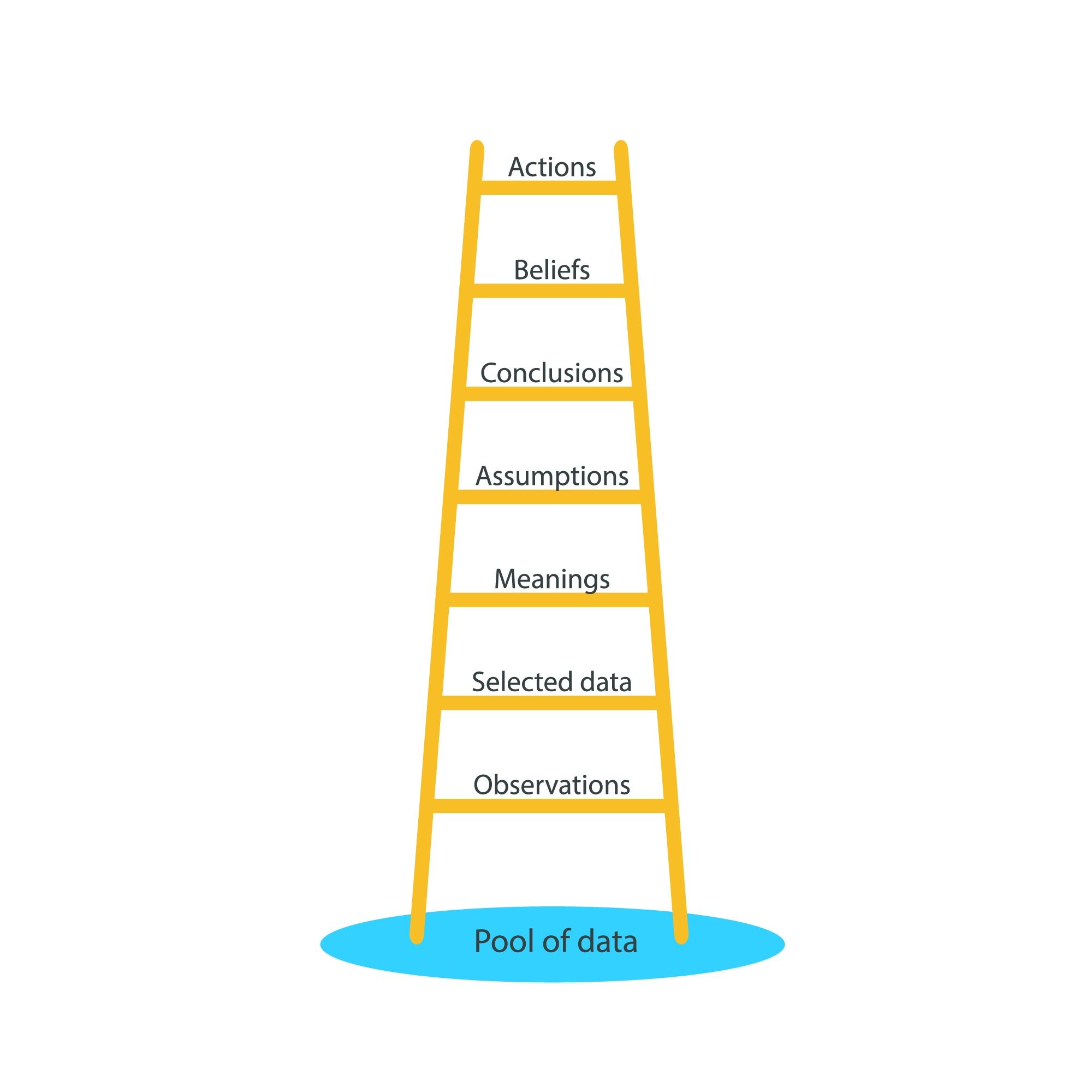
Actions
The visible behaviors and decisions we execute. These are often reactive and based on the reinforced cycles of our internal beliefs.
Beliefs
The rigid worldviews we adopt. Once a conclusion is repeated, it becomes a 'truth' that filters all future incoming information.
Conclusions
The final judgments we draw. We stop questioning our logic at this stage and commit to a specific interpretation of reality.
Assumptions
The 'logical' leaps we make. We fill in the gaps of missing information with our own biases without realizing we are doing so.
Meanings
The cultural and personal context we add. We attach 'labels' to the data based on our past experiences and societal conditioning.
Selected Data
The cognitive filter. We subconsciously ignore 99% of reality to focus on the 1% that matches our existing expectations.
Observations
The initial capture of data. Even at this basic level, our focus is limited by what we are physically or mentally prepared to see.
Pool of Data
The raw, unfiltered reality. This is the 'ground truth' that contains all possible information before any human processing occurs.